
Amazon Agency Management・TikTok Agency Management
E-Commerce Agency Management in Southeast Asia・Shopify Development
Global Logistics・EU & US Fulfilment Centres・Overseas Marketing
Amazon Agency Management・TikTok Agency Management
E-Commerce Agency Management in Southeast Asia・Shopify Development
Global Logistics・EU & US Fulfilment Centres・Overseas Marketing

Zhongshan Ancient Town boasts a lighting industry cluster with an annual output value exceeding 120 billion yuan, and its products are exported to more than 130 countries and regions. There is no shortage of production capacity or products here. What it lacks is the online channel that can deliver products directly to overseas consumers.
At the end of 2025, a professional lighting manufacturer based in Zhongshan entered into a partnership with Shenzhen 1981 Technology Co., Ltd. The client has been deeply engaged in the lighting foreign trade business for many years with a stable supply chain and distinct manufacturing advantages in its products. It planned to launch a brand-new account on Amazon US to build its own online brand. Prior to this, however, the client had no experience in platform setup and operational implementation. Everything from account registration, category compliance, localized Listing creation, ad campaign launching to inventory scheduling had to be built from scratch
After the 1981 Technology Team took over, they did not rush to launch products or run ads. Instead, they first carried out a foundational assessment: lighting is a visually driven category, yet consumers purchasing lights on Amazon care about more than just aesthetics. They also pay attention to dimensions, installation, compatibility, packaging damage and replacement parts for after-sales service. The factory’s strength lies in manufacturing, while its weakness is turning products into product listings that online shoppers can understand, trust and buy. Based on this assessment, the team developed an integrated launch plan from scratch covering five modules: product portfolio planning, localized Listing creation, advertising system setup, inventory rhythm management, and brand compliance arrangement.
Product Matrix: More is not always better. Lighting SKUs vary widely in installation methods, power supply structures, transportation risks and after-sales complexity. Large chandeliers command high unit prices, yet they carry elevated risks related to bulkiness, glass breakage and installation consultation. The team worked with clients to tier the product line: for the first phase, resources were focused on validating core models with relatively stable structures, manageable packaging and distinct differentiators. These SKUs were used to refine the conversion model and after-sales workflow, and the pace of product expansion would then be determined based on data. A large number of variants were not launched at the initial stage to prevent the dilution of budget and inventory.
Listing: Focus on both attractive appearance and easy installation. US marketplace shoppers have clear information needs regarding lighting fixtures, including size proportions, compatible voltage, bulb specifications, dimming compatibility and installation procedures. The team hierarchically arranged style descriptors, functional terms and scenario keywords within titles, bullet points and A+ content pages. The main image accurately displays the lamp body and package contents, while secondary images and lifestyle visuals answer key questions: where to install it, how to install it, and which light sources work with it. Localization is not mere translation; it means restructuring product information into the language that US consumers rely on to make purchase decisions.
Advertising: Conduct phased verification instead of pursuing large-scale launch from the start. In the early stage of a new product launch, the primary goal of advertising is to verify whether the search terms are accurate, whether the main images can reach the target audience, and what questions users mostly inquire about. In the second stage, the team screens converted root words by category terms, style terms, scenario terms and long-tail installation terms, and optimizes titles, image sequences and advertising structures simultaneously. The advertising budget should be adjusted based on data rather than the impulse to "scale up quickly".
Inventory and Compliance: The hidden costs of lighting products lie in after-sales services. Broken lamp shades, damaged glass components, missing screws and unclear instruction manuals are common causes of returns and negative reviews for lighting products. Before the first batch was warehoused, the team completed packaging tests and formulated protection solutions for fragile parts, and set up a replacement part process for components with frequent issues. In terms of compliance, documents were verified item by item for the power supply modes, wireless functions and light source structures of different SKUs to avoid listing risks caused by generic certification checklists.
After the project was launched, growth gradually got on track. As of October 20, 2026, the operating data of this account for the year to date are as follows:
Total cumulative number of ordered items: 57,195
Ordered quantity: 72,355
Sales of ordered goods: US$8,108,321.50
Average items per order: 1.27
Average sales per order item: US$141.77
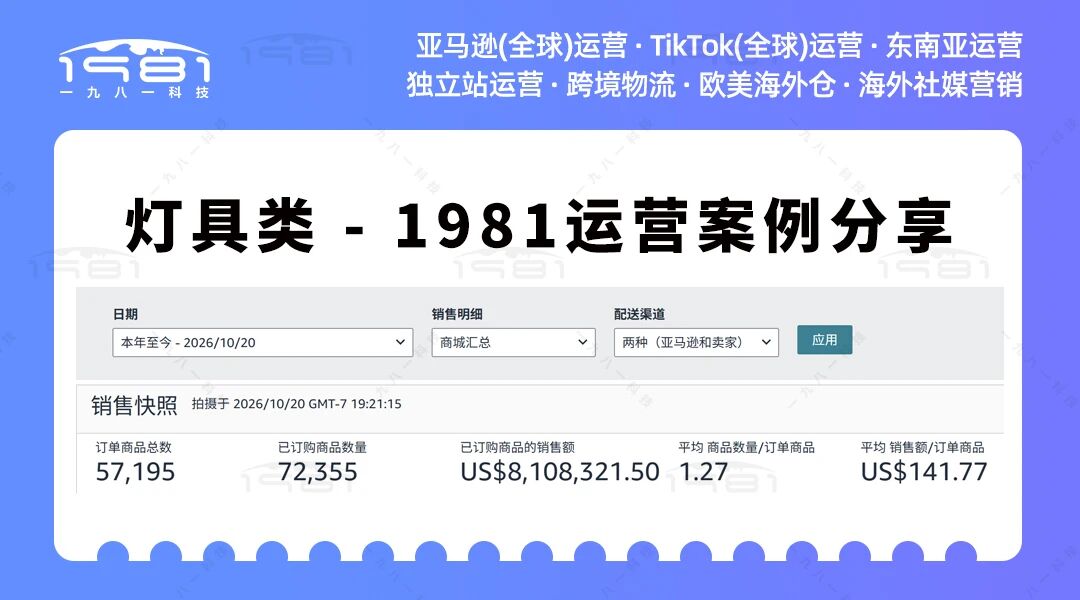
A newly registered account built from scratch has secured a brand position in the home lighting category on the US marketplace within less than a year of operation. The client is satisfied with the current operating results, and the plan for the next phase has been defined: continue expanding SKUs, explore niche subcategories, and leverage the Black Friday and Christmas peak seasons to hit higher sales targets. Meanwhile, the rollout for the European and Australian markets is underway.
Looking back at this case, several prerequisites are worth noting: the client has a stable supply chain and manufacturing experience, which serves as the foundation on the product side. On the operations side, the strategy adopted was to conduct diagnostics and planning first before scaling up gradually, instead of resorting to mass distribution or price wars to chase short-term performance metrics at the launch stage. The division of responsibilities between the team and the factory was clear: the factory was responsible for delivering quality products, while the operations team refined product presentation, traffic acquisition and fulfillment scheduling on the platform. Lighting export is not a business that relies on sudden breakthroughs in a single area. Establishing a sound basic framework covering compliance, listing pages, inventory and advertising during the launch phase creates a reliable foundation for subsequent product expansion and peak-season campaigns.
Scan the code to consult the 1981 Technology Team if you need to learn more details about cross-border e-commerce operations.
The submission window for Black Friday and Cyber Monday deals is drawing to a close. For sellers, this is a ti...

Amazon’s recent moves regarding reviews and ads are worth cross-border teams re-evaluating from an operational per...

Autumn ushers in a new chapter as we forge ahead with determination. To review September’s work, set the priori...
 info@us1981.com
 +86 400-777-1981

Copyright © 2015-2026 Shenzhen 1981 Technology Co., Ltd. All Rights Reserved.
 简体中文
 한국어
 Việt nam
 日本語
 Deutsch
 En français
 Italiano
 Español



 info@us1981.com
