
Amazon Agency Management・TikTok Agency Management
E-Commerce Agency Management in Southeast Asia・Shopify Development
Global Logistics・EU & US Fulfilment Centres・Overseas Marketing
Amazon Agency Management・TikTok Agency Management
E-Commerce Agency Management in Southeast Asia・Shopify Development
Global Logistics・EU & US Fulfilment Centres・Overseas Marketing

On November 1, 2025, the official website of the White House formally announced a series of adjustments to U.S. trade policy towards China, with the new regulations set to take effect on November 10. This policy shift covers multiple areas including tariffs, export controls, and port fees. It is widely viewed as initiating a one-year "truce phase" in Sino-U.S. economic and trade relations, bringing long-awaited certainty to the bilateral trade environment.
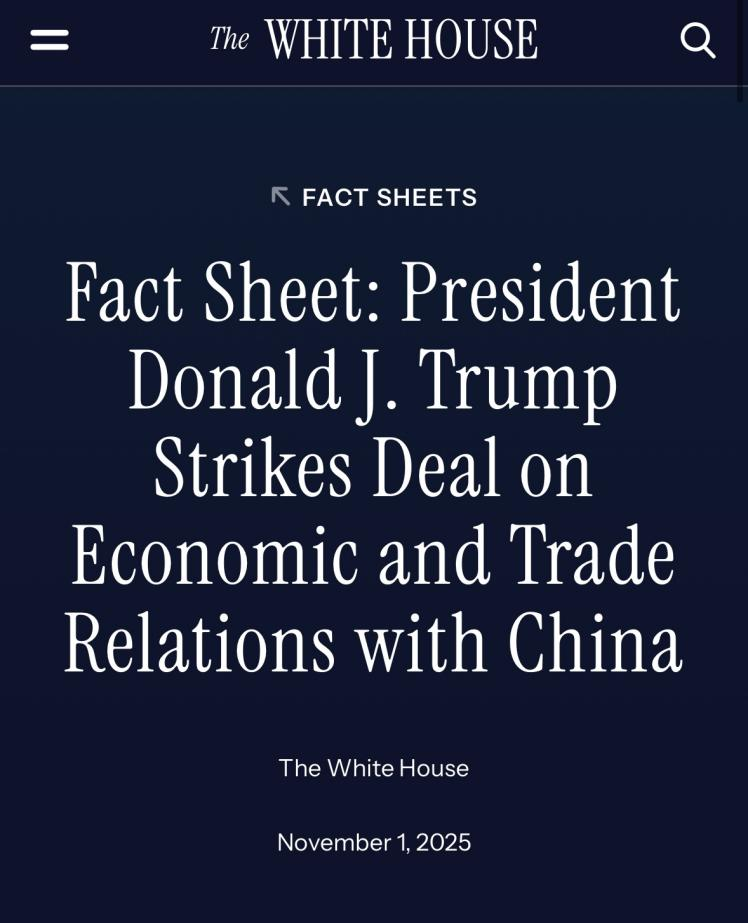
(Image Source: The White House Official Website)
Substantial Adjustments in Tariff Policy
The changes in tariff policies are the most direct in this adjustment. The closely watched "Fentanyl Tariff" will be reduced by 10 percentage points from the original 20% to 10%.
Furthermore, the suspension status of the "Reciprocal Tariffs," originally set to expire on November 10 this year, will be extended until November 10, 2026, maintaining the current rate of 10% during this period. The exclusion list for Section 301 tariffs has also been synchronously extended until November 10 next year, covering 178 tariff line items including machinery and equipment, electric vehicles, batteries, semiconductors, and other key links in multiple industrial chains.
Simultaneous Easing of Export Controls and Shipping Restrictions
In addition to tariffs, the U.S. side has made significant concessions regarding non-tariff barriers. The widely discussed "50% Export Control De Minimis Rule" will be suspended for one year. This rule previously required products using more than 50% U.S. technology or components to obtain U.S. approval for export to China. Its suspension provides a crucial buffer for global supply chain enterprises.
In the shipping sector, the U.S. announced the suspension of additional port call fees for Chinese vessels, while also postponing Section 301 investigation-related measures targeting China's maritime, logistics, and shipbuilding industries. China has reciprocally responded by suspending corresponding countermeasures, creating a two-way policy benefit.
Rapid Recovery in Foreign Trade Market, Enterprises Welcome a Critical Window
The positive policy news has quickly transmitted to the market. Taking Shenzhen's Yantian Port as an example, on October 31, it accommodated 8 cargo ships on U.S. routes, with daily container handling volume accounting for nearly 60% of the port's total. Some cross-border logistics companies revealed that within 24 hours of the policy announcement, inquiries for shipments to the U.S. increased by over 30%, with many North American clients restarting inquiries for Christmas season orders.
These policy adjustments are closely related to the consensus reached during the recent meeting between the heads of state of China and the U.S., where progress was made on issues including fentanyl control, agricultural trade, and handling specific company cases. Foreign trade enterprises should seize this one-year "truce period" to accelerate cost optimization and customer consolidation. As an Amazon SPN Service Provider, 1981 Tech will continue to monitor policy developments, committed to providing efficient service support for enterprises and jointly seizing the market window of opportunity.

On September 21, the 2027 Amazon Global Selling Hangzhou Site Service Provider Launch Conference was held in Hang...
Amazon business is increasingly testing real capabilities. The era of generating sales through mass listing and lo...

Manufacturing enterprises have products and supply chains, which form the most solid foundation for going global. ...
 info@us1981.com
 +86 400-777-1981
Copyright © 2015-2026 Shenzhen 1981 Technology Co., Ltd. All Rights Reserved.
 简体中文
简体中文
 한국어
한국어
 Việt nam
 日本語
日本語
 Deutsch
 En français
 Italiano
 Español



 info@us1981.com